
- Home
- Products
- About Us
- Download
- News
- Blog
- Contact Us
Leave Your Message
Choosing the right Termination Kits for 2026 requires more than comparing prices or catalog images. Cable voltage, conductor size, insulation material, installation space, and weather exposure all influence long-term performance. A kit designed for indoor switchgear may fail prematurely in a coastal substation. Salt, moisture, heat, and installation errors leave visible clues.
Dr. Paul Cook, a pioneer in polymeric cable accessories and founder of Raychem, said, “The reliability of a system depends on the reliability of every connection.” This principle remains highly relevant. A well-engineered termination must control electrical stress, seal against moisture, and maintain stable mechanical pressure. It should also support clear installation instructions, traceable components, and practical field testing.
The leading Termination Kits in 2026 are expected to combine heat-shrink, cold-shrink, and premolded technologies. Each option has strengths, but none is perfect. Heat-shrink kits need controlled heating and clean surfaces. Cold-shrink kits reduce flame risks, yet storage conditions still matter. Premolded designs can simplify installation, although size compatibility must be checked carefully.
Small details matter.
This guide examines product design, voltage ratings, material quality, installation demands, and manufacturer support. It also considers less obvious concerns, including shelf life, tool availability, training, and performance in harsh environments. Some rankings may remain debatable. Real-world results can differ between laboratories and busy worksites. That uncertainty deserves honest attention when selecting Termination Kits for critical electrical networks.
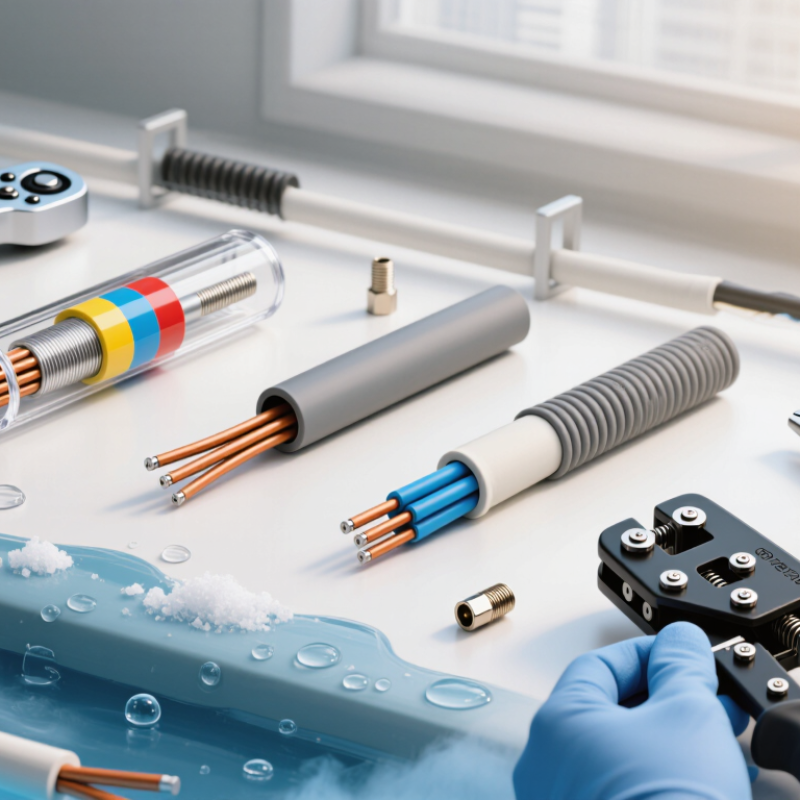
Termination kits are engineered assemblies that finish a cable safely at a switchgear, transformer, or overhead connection. They control electrical stress where insulation ends. They also seal moisture, maintain screen continuity, and protect against tracking.
A cold-shrink kit uses pre-expanded silicone or rubber parts. The installer removes a support core, allowing the material to contract around the cable. It needs no open flame. A heat-shrink kit uses controlled heat to recover insulating tubes and sealants. It is practical, but uneven heating can create weak points. Premolded and slip-on kits arrive with stress-control components already formed. They usually offer consistent geometry and faster installation. Separable connectors suit compact switchgear and allow later disconnection. No kit fits every cable.
The IEA’s Electricity 2024 report forecasts electricity demand to grow by an average 3.4% annually through 2026. More energized assets increase the value of reliable terminations. IEEE Std 48-2020 covers alternating-current cable terminations rated from 2.5 kV to 500 kV. IEC 60840 addresses extruded-insulation cables above 30 kV and up to 150 kV. These ratings help narrow the selection, but they do not replace field judgment.
I check conductor size, insulation diameter, screen design, voltage class, and installation space. I also verify torque values and sealing surfaces. That step is easy to rush. It should not be. Site temperature, contamination, bending, and installer training can change the result. A technically compliant kit may still fail when the preparation is careless.
A termination kit contains the tools and consumables needed to finish a cable end, attach a connector or lug, provide strain relief, and protect the connection from moisture, contamination, and mechanical damage.
| Rank | Termination Kit Type | Primary Cable or Connector | Typical Kit Components | How It Works | Best Use in 2026 | Important Selection Criteria |
|---|---|---|---|---|---|---|
| 1 | Fiber Optic Field-Termination Kit | Single-mode fiber Multimode fiber LC SC | Fiber stripper, precision cleaver, connector fixtures, cleaning wipes, lint-free swabs, inspection scope, polishing materials, and a visual fault locator. | The kit removes the fiber coating, cleaves the glass, aligns the fiber with a connector ferrule, and secures the connection by mechanical retention or adhesive and polishing. | Data centers, enterprise networks, and fiber-to-the-building installations | Connector compatibility, cleaver accuracy, inspection capability, splice or connector method, and support for the required fiber type. |
| 2 | Mechanical Fiber Splice and Termination Kit | Single-mode fiber Multimode fiber Drop cable | Fiber stripper, cleaver, alignment sleeves, mechanical splice holders, cleaning supplies, splice protection sleeves, and a visual fault locator. | Two prepared fiber ends are aligned inside a precision sleeve or splice body. Index-matching gel or mechanical alignment reduces optical loss without fusion equipment. | Rapid repairs, low-volume installations, and locations without mains power | Splice loss, environmental sealing, cable diameter range, installation temperature, and compatibility with the fiber construction. |
| 3 | Copper RJ45 Field-Termination Kit | Cat 5e Cat 6 Cat 6A 8P8C plugs | Cable jacket stripper, conductor separator, load bars or termination guides, crimp tool, plug boots, cable tester, and spare modular plugs. | The twisted-pair conductors are arranged according to the selected wiring scheme and pressed into the contacts. The contact blades pierce the insulation to create an electrical connection. | Structured cabling, access points, cameras, and network equipment patching | Category rating, conductor size, solid or stranded cable support, shielded or unshielded construction, and certification-test requirements. |
| 4 | Shielded Ethernet Termination Kit | F/UTP S/FTP Cat 6A | Shielded plugs or jacks, foil and braid preparation tools, cable jacket stripper, drain-wire handling accessories, crimp or termination tool, and continuity tester. | The cable pairs are terminated while the foil, braid, and drain path remain electrically continuous through the connector or jack housing. | Industrial networks, high-interference areas, and high-bandwidth copper links | Shield continuity, grounding method, connector category, cable outer diameter, bend radius, and compatibility with the installation standard. |
| 5 | Low-Voltage Power Cable Heat-Shrink Kit | Control cable Battery cable Low-voltage power | Cable preparation tools, crimp lugs or terminals, calibrated crimper, adhesive-lined heat-shrink tubing, cleaning materials, and a controlled heat source. | A properly sized terminal is compressed onto the conductor. Heat-shrink tubing contracts around the joint and, when adhesive-lined, helps seal the connection against moisture. | Control panels, battery systems, automation equipment, and outdoor low-voltage wiring | Conductor cross-section, terminal material, current rating, insulation temperature rating, tubing shrink ratio, and required environmental protection. |
| 6 | Medium-Voltage Cable Termination Kit | Shielded MV cable Elbow or lug termination Power distribution | Stress-control components, semiconductive-screen removal tools, insulation preparation tools, lugs or connectors, grounding components, sealing materials, and installation instructions. | The kit controls the electrical field at the end of the shielded cable, restores insulation geometry, connects the conductor, and seals the termination against environmental ingress. | Utility distribution, industrial substations, and medium-voltage equipment | Voltage class, conductor size, insulation diameter, screen type, installation environment, applicable testing requirements, and installer qualification. |
| 7 | Cold-Shrink Outdoor Termination Kit | Power cable Control cable Outdoor circuits | Pre-expanded elastomeric sleeve, stress-control parts where required, cable seal, grounding accessories, cable preparation tools, and installation lubricant. | The sleeve is positioned over the prepared cable and its removable support core is pulled out. The sleeve contracts uniformly to create insulation, sealing, and strain relief. | Outdoor installations where a torch or open flame is undesirable | Cable diameter range, temperature rating, UV and weather resistance, voltage class, water-sealing performance, and shelf life. |
| 8 | Heat-Shrink Cable Termination Kit | Power cable Control cable Indoor or outdoor | Heat-shrink tubing, stress-control tubing or mastic, sealing components, cable lugs, grounding parts, cleaning supplies, and a suitable hot-air tool or gas torch. | The components are positioned over the prepared cable and heated so they shrink around the insulation and conductor, forming a sealed and mechanically supported termination. | Permanent installations with controlled heating access | Voltage rating, cable insulation diameter, shrink temperature, flame-safety requirements, environmental sealing, and required clearances. |
| 9 | Coaxial Cable Termination Kit | RG-type coaxial cable BNC TNC F-type | Coax stripping tool, compression or crimp tool, interchangeable dies, connectors, center-conductor preparation tools, and a continuity or return-loss tester. | The jacket and dielectric are stripped to expose the braid and center conductor. The connector is crimped or compressed to preserve the cable’s impedance and shielding. | RF systems, video surveillance, broadcast, and antenna installations | Cable impedance, connector interface, frequency range, shielding coverage, connector attachment method, and return-loss performance. |
| 10 | Ruggedized Industrial Cable Termination Kit | Industrial Ethernet Sensor cable Control cable | Heavy-duty connectors, sealing glands, strain-relief parts, shield clamps, insertion and extraction tools, cable preparation tools, and verification equipment. | The conductors or optical fibers are connected inside a sealed connector system. Glands and strain relief protect the termination from vibration, dust, water, and cable movement. | Factories, transport systems, outdoor cabinets, and harsh operating environments | Ingress-protection rating, vibration resistance, temperature range, connector locking method, cable diameter, and EMC shielding requirements. |
Selection note: The best termination kit depends on cable type, conductor or fiber size, connector interface, voltage or category rating, installation environment, and the required test procedure. Always follow the cable and connector manufacturer’s instructions, applicable electrical codes, and the relevant installation standard.



 Send Email
 Phone
Phone whatsapp
 Wechat
 Whatsapp
